


Introduction to Precept Practice

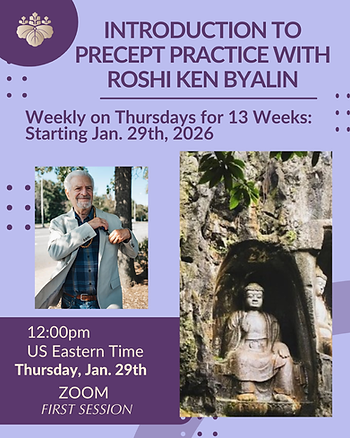
What a gift, to be able to share some of what I’ve been given in my life with others. The Zen Peacemakers have been giving me a chance to share some of the gifts from my teachers. Next up, the Zen Precepts.
The Precepts, the Buddhist guides to ethical conduct, could easily have scared me off. I came to precepts with the Ten Commandments in my head. Although the Commandments were not part of my atheist family culture, they were there in the mid-20th century American air of my childhood. A lot of prohibitions. Don’t break the rules. I wasn’t good at rules.
I was fortunate to come to the Precepts via Roshi Bernie Glassman’s second Ox course. Roshi Jishu Holmes, who taught my Precept course, showed me how to use the precepts as tools for self-study. Jishu taught me to work with the precepts as mirrors for self-reflection, rather than as rules for judging myself or others. We worked for a month on each of the Ten Grave Precepts. For the first three weeks, each evening, I journaled the moments of the day in which the precept of the month had arisen. During the final week, I wrote a reflection on what had come up. The months that I spent on “anger” and on “talking about others’ errors and faults” were immediately life changing. I’ve been working with the precepts now thirty years, an inexhaustible resource for personal transformation.
By shifting the focus to mirrors from rules, Bernie and Jishu gave me a wonderful gift, and I have been celebrating it ever since, always happy to share this practice, but recently I became concerned – credit Aitken Roshi with this insight – that in turning the precepts inward, my, our, practice became one-sided. Had we thrown out the baby with the bathwater? Have we neglected the ethical component? Would, perhaps, some of the moral excesses of my fellow Zen teachers have been avoided if we’d paid more attention to the rules?
So, I’ve put the rule part of the practice back in. During the first month of work with a precept, we used it as mirror, just as I did with Jishu, looking inward, and writing reflections. During the second month, while we were doing mirror-practice with the next precept, we turned the first precept outward. Choose a change in your life that you’d like to make with that precept and go at it. Now, each night there is a second journal entry. Did you follow your rule that day? Did you mess up? How did it feel to follow the rule? How did it feel when you didn’t? What’s coming up as you reflect on your practice that day? The heart of the practice remains self-study. What are you learning about yourself from your “successes” and your “failures”? The rule that you work with can be quite simple. “For the next month, I am not going to honk my horn in anger.”
This time around with the Peacemakers, I’m trying something else new. We’ll be working in weeks rather than in months. Is that enough time? There is never enough time. Whether we work in weeks or months or years, our work is never more than an introduction to precept practice. The precepts are koans with which we never finish, which we never pass, which we return to over and again throughout our lives. Interested in taking the plunge. Why not join us? Register for the class on the Zen Peacemaker website. I’d love to see you there.


Comments